
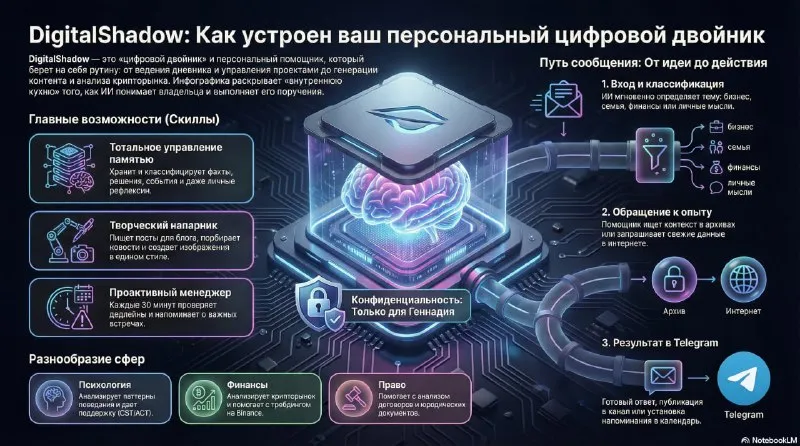
Digital Shadow v1.0 grew out of one of my weak spots: operations and administration regularly break my focus. I built a personal AI memory that keeps tasks, people, files, and previous decisions in one working context.
The problem with scattered context
Creative founders rarely run out of ideas. Reconstructing the operational trail is harder: who promised what, where a file lives, why we rejected an approach six months ago, which deadline a partner gave us, and what I decided last Tuesday.
That information is spread across Telegram, documents, notes, email, GitLab, and memory. Returning to a task becomes a manual search through several systems.
A summary of a Gartner survey reported that 47% of digital workers struggle to find the information or data they need for their jobs.
“47% of digital workers struggle to find information or data needed to effectively perform their jobs.” — Gartner survey summary
Source: Gartner survey summary
Many teams face the same problem. They produce more information than they can retrieve at the moment it becomes useful.
What Digital Shadow keeps
Digital Shadow acts as external working memory for a founder. I can send it thoughts, documents, meeting notes, photos, agreements, and project decisions.
The first version can:
- turn a thought dump into a structure;
- help plan tasks;
- retain facts, dates, and people;
- store photos, files, and documents;
- retrieve previous attempts and their outcomes;
- restore project context without a manual search.
How AI memory retrieves context
A note stays passive until someone remembers it and searches for the right file. Digital Shadow selects related context while I ask a question or plan work.
A regular chat works well inside one conversation. This system needs a persistent memory layer across legal and finance work, crypto trading, software architecture, and operations.
How v1.0 works
Telegram became the interface because it already sits inside my daily communication. The memory layer and LLM run on my server. I keep control of the data and can adapt the system to the workflows I use.
NIST describes trustworthy AI through characteristics such as usefulness, safety, transparency, privacy, and governance within the system's context.
“Creating trustworthy AI requires balancing each of these characteristics based on the AI system’s context of use.” — NIST AI RMF
Source: NIST AI Risk Management Framework
Personal AI memory holds documents and decisions. It needs access boundaries, clear storage rules, deletion controls, and an explicit policy for what enters the model context.
Where the value appears
The system reduces the load on working memory:
- a contract is available without browsing folders;
- project context returns without a full reconstruction;
- partner commitments stay linked to the relevant work;
- the history of earlier decisions prevents repeated mistakes;
- switching between projects takes less time.
Digital Shadow helps a founder preserve context. People remain responsible for priorities and decisions.
What I learned from v1.0
When routine work repeatedly breaks focus, moving part of memory into a system can help. Digital Shadow v1.0 already brings back project context, retrieves earlier decisions, and reduces mental overhead. The next versions will grow around those observed workflows.