
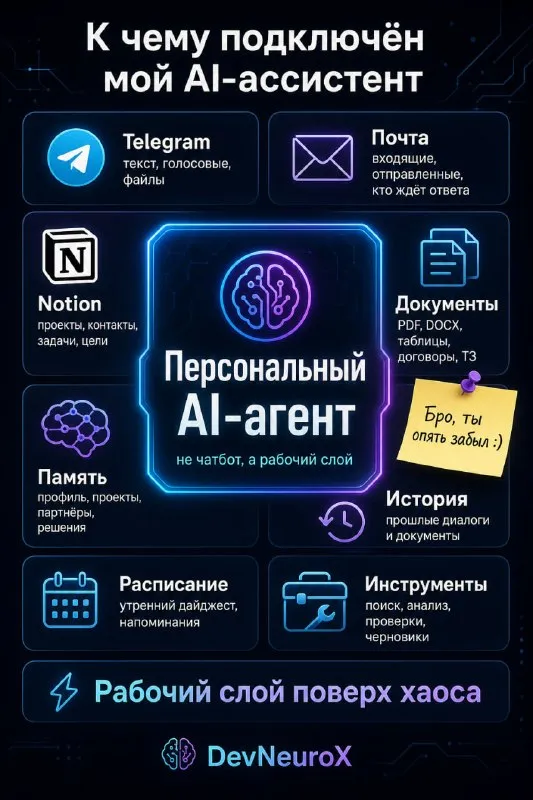
A founder can benefit from a working layer that connects project memory, messages, documents, and tasks. A personal AI assistant assembles the day and surfaces relevant context while leaving decisions to the person.
When work systems multiply
My workday includes DevNeuroX, clients, partners, Telegram, email, meetings, documents, urgent tasks, and late-night notes. I cannot retain every relationship among them in memory.
Calendars, task lists, and Notion help, but each system also needs maintenance. The work itself gains a second layer of work required to manage its tools.
That is why I built a personal AI assistant in Telegram. It preserves context, reminds me about related events, and helps process accumulated input.
How an assistant differs from a chatbot
A chatbot answers the current question. An assistant participates in a process and uses several types of data:
- the person's preferences, rules, and working style;
- project roles, decisions, and history;
- Telegram, email, documents, Notion, search, and calendars;
- schedules for digests, reminders, and checks;
- limits on independent actions.
Anthropic describes retrieval, tools, and memory as basic additions to a language model in an agentic system:
“The core building block of agentic systems is an LLM enhanced with augmentations such as retrieval, tools, and memory.” — Anthropic, Building Effective AI Agents
Source: Anthropic, Building Effective AI Agents
The model processes a request, memory returns context, and tools read data or perform permitted operations. Their combination turns a conversational interface into an assistant for daily work.
Connections should follow the real process
My setup includes Telegram, voice messages, email, Notion, documents, web search, schedules, reminders, cron digests, and project memory. The number of integrations has little value on its own.
An assistant should see data where the work actually happens. Every unnecessary connection adds noise and increases access risk.
Anthropic describes MCP's purpose this way:
“MCP is a new standard for connecting AI assistants to the systems where data lives…” — Anthropic
Source: Anthropic, Introducing the Model Context Protocol
The protocol simplifies technical connections to context and tools. Access rules and responsibility for each action still belong to the system design.
What a morning digest provides
Each morning, the assistant can assemble a concise picture of the day:
- approaching deadlines;
- contacts waiting for a reply;
- task changes;
- detected risks;
- questions requiring attention;
- topics that can wait.
The digest draws from messages, email, tasks, and earlier decisions. Its job is to show what matters without an 80-line wall of secondary detail.
Context links are more useful than a timer. For example, the assistant can explain that a person is waiting for an estimate promised yesterday and that the response deadline relates to a specific client task.
Daily working modes
Contextual reminders. Along with the call time, the assistant provides participants, earlier agreements, open questions, and preparation material.
Email and messages. It drafts replies, summarizes long threads, and adjusts tone for the recipient.
Documents. The assistant helps with proposals, specifications, estimates, plans, presentations, PDFs, and tables.
Search and research. It collects sources, extracts key facts, and labels assumptions.
Idea processing. A collection of notes becomes tasks, risks, and next actions.
A post, email, proposal, estimate, or presentation outline used to take hours or days. Working with the assistant often reduces the first usable version to 15–60 minutes in my process.
That is an observation from my own workflow, not a promise of identical results for every team. Savings depend on source data, templates, and review quality.
Errors must remain controllable
An assistant may associate a person with the wrong project, misunderstand a relationship among events, or reach a premature conclusion. The system needs to make such mistakes visible and easy to correct.
A practical design exposes the basis of an answer, accepts corrections, stores rules explicitly, and grants minimal permissions. Sensitive actions always pause for confirmation.
OpenAI describes that mechanism this way:
“The model can still decide that an action is needed, but the run pauses until you approve or reject it.” — OpenAI API Docs
Source: OpenAI API Docs, Guardrails and approvals
The assistant can suggest and prepare an action. Important emails, documents, financial operations, and commitments remain under human control.
The model is a replaceable component
The system should not depend on one model. One option may write better, another may process documents at lower cost, and a local model may suit sensitive data.
More stable parts preserve the working layer:
- memory;
- tools;
- rules;
- logs;
- schedules;
- approvals;
- project context.
See the DevNeuroX personal AI assistant for the related service surface.
Who benefits from this setup
A personal assistant is particularly useful for founders, project leads, small-team managers, and consultants. They share a high volume of parallel communications, documents, and meetings.
The system may be excessive for one clear task and two emails a day. With ten projects, three messengers, email, meetings, and constant urgent requests, it returns attention previously spent rebuilding context.
A good AI assistant does not replace thinking. It clears working memory for decisions that genuinely require the founder's involvement.