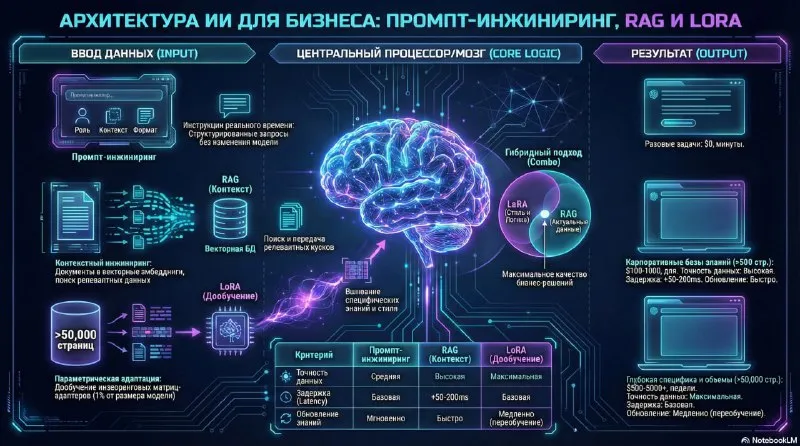
Prompts, RAG, and LoRA solve different problems. A prompt defines the rules, RAG supplies current knowledge, and LoRA adapts model behavior for a repeated task.
A good instruction is usually enough for the first prototype. Add the next layer after measuring quality: RAG helps with documents, while LoRA addresses stable requirements for style, format, or specialization.
The short choice
- A prompt describes the role, task, constraints, and output format.
- RAG retrieves suitable documents before the model responds.
- LoRA adds a trainable adapter for the required behavior.
A one-off or general task usually starts with a prompt. Internal documents and changing facts call for RAG. LoRA becomes relevant for a repeated workflow with a reliable dataset of examples.
A prompt defines the instruction
Prompt engineering makes the model's role, output format, limits, and quality criteria explicit.
Weak request: “Write a post about AI trading.”
Working request: “Write a Telegram post about AI trading. Use a direct tone with light self-irony. Include one real failure, explain the risk, and end with a founder takeaway.”
Prompt advantages:
- quick to test;
- little infrastructure;
- easy to change;
- suitable for prototypes and one-off work.
Limits:
- company specifics have to enter the context;
- a large document set overloads the request;
- quality depends heavily on the instruction.
RAG connects a knowledge base
RAG fits policies, contracts, product documentation, knowledge bases, and project history. These sources change and often exceed a reasonable prompt size.
The system splits documents into chunks, creates embeddings, and stores them. When a question arrives, retrieval selects related chunks and places them in the model context.
The original paper describes RAG as a combination of a model's parametric memory and non-parametric memory available through retrieval.
“RAG models combine pre-trained parametric and non-parametric memory for language generation.” — Lewis et al., 2020
Source: Retrieval-Augmented Generation for Knowledge-Intensive NLP Tasks
RAG gives the system current internal knowledge and can expose the sources behind an answer. Its quality depends on document structure, chunking, retrieval, and access rules.
RAG advantages:
- knowledge updates without model training;
- answers use company documents;
- the system can show its sources;
- permissions can restrict individual data sets.
Limits:
- retrieval and storage infrastructure is required;
- poor chunking weakens the results;
- a disorganized knowledge base produces weak answers;
- privacy needs its own design.
LoRA adapts model behavior
LoRA fits stable style, output format, or specialized behavior. Facts that change frequently are easier to maintain in an external knowledge base.
The method freezes the base model weights and adds trainable low-rank matrices to Transformer layers. This reduces the number of parameters involved in training.
“LoRA ... freezes the pre-trained model weights and injects trainable rank decomposition matrices into each layer of the Transformer architecture.” — Hu et al., 2021
Source: LoRA: Low-Rank Adaptation of Large Language Models
The result is a small adapter for one task instead of a full model retraining run.
LoRA advantages:
- consistent style and format;
- fewer trainable parameters than full fine-tuning;
- adapters can run locally;
- useful for repeated specialized tasks.
Limits:
- the dataset must be reliable;
- preparation and evaluation take time;
- facts are harder to update than in RAG;
- dataset errors become part of the behavior.
Decision tree
Use a prompt for a one-off task, a small amount of data, a fast hypothesis test, or an output that a person can verify quickly.
Add RAG when the model answers from documents, the knowledge base changes, sources must be visible, or access needs to be separated.
Consider LoRA when the output requires a stable format, you have a tested dataset, the task repeats often, and RAG already supplies the required facts.
How the methods work together
In production, these methods often share one workflow. A system prompt defines the role and rules, RAG provides current facts, and LoRA stabilizes specialized behavior when measurements justify it.
Start with a prompt and measure quality. Add context next. Tuning makes sense when the evidence shows a persistent model-behavior problem.